
 Custom Manufacture :
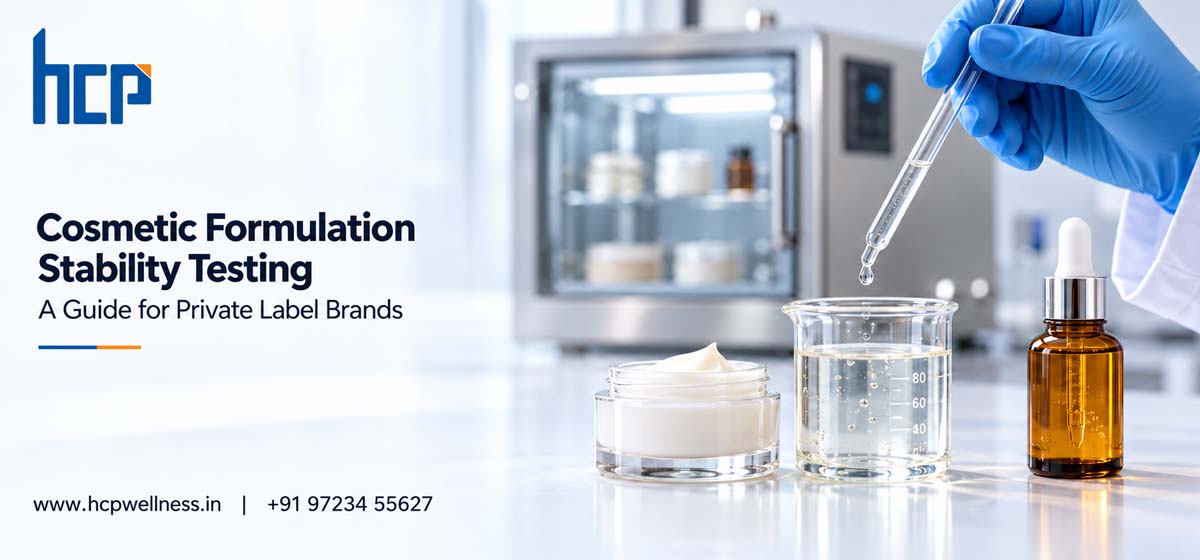
Cosmetic formulation stability testing checks whether a skincare, haircare, or personal care product remains safe, effective, and visually consistent throughout its shelf life. For private label brands, it is a crucial step before launching a product under your own brand name.
A well-formulated product can still fail in the market if it separates, changes colour, develops an unpleasant smell, loses viscosity, or irritates users after storage. Stability testing helps identify these issues early—before bulk manufacturing, packaging, and distribution.
What Is Cosmetic Formulation Stability Testing?
Cosmetic stability testing is the process of storing a formulation under controlled conditions and monitoring changes over time. It evaluates how a product reacts to factors such as heat, light, humidity, air exposure, and packaging material.
The goal is to confirm that the product maintains its:
- Appearance, colour, and texture
- Fragrance and odour
- pH level
- Viscosity and spreadability
- Ingredient performance
- Microbiological safety
- Packaging compatibility
For private label cosmetic brands, stability testing protects both product quality and brand reputation.
Why Stability Testing Matters for Private Label Brands
Private label brands often launch creams, serums, shampoos, face washes, sunscreens, lotions, and other personal care products through a contract manufacturer. Since the manufacturer handles formulation and production, stability testing becomes an important quality checkpoint.
It helps brands:
- Avoid product separation or phase splitting
- Prevent colour changes and unpleasant odour
- Confirm shelf-life claims
- Reduce customer complaints and returns
- Ensure packaging does not react with the formula
- Meet quality and regulatory expectations
- Build buyer confidence in retail, salon, pharmacy, and export markets
A product that looks perfect on day one may not remain stable after three, six, or twelve months. Testing helps detect these risks before the product reaches customers.
Types of Cosmetic Stability Tests
Real-Time Stability Testing
Real-time testing stores the product at normal room temperature for its expected shelf life. It provides the most accurate picture of how the product performs in real storage conditions.
This test is useful for confirming:
- Long-term shelf life
- Gradual changes in texture or colour
- Packaging compatibility
- Overall product performance
Accelerated Stability Testing
Accelerated testing stores the product at higher temperatures and humidity levels to simulate ageing faster. It helps manufacturers identify potential formulation problems in a shorter time.
Common accelerated conditions include:
- Elevated temperature storage
- High humidity exposure
- Freeze-thaw cycles
- Light exposure testing
Accelerated testing does not replace real-time testing, but it gives early insights into formulation weaknesses.
Microbial Challenge Testing
Microbial challenge testing checks whether the preservative system can protect the product from microbial contamination. This is especially important for water-based products such as creams, lotions, gels, shampoos, and face washes.
It evaluates protection against common microbes and helps ensure the product remains safe during consumer use.
Packaging Compatibility Testing
The formula must remain stable not only in a laboratory container but also in its final packaging. Packaging compatibility testing checks whether the bottle, tube, jar, pump, sachet, or airless container affects the product.
Packaging Compatibility Testing
The formula must remain stable not only in a laboratory container but also in its final packaging. Packaging compatibility testing checks whether the bottle, tube, jar, pump, sachet, or airless container affects the product.
It can identify issues such as:
- Ingredient absorption into packaging
- Leakage or evaporation
- Discoloration
- Changes in fragrance
- Pump or dispenser malfunction
Key Parameters Checked During Testing
A professional cosmetic manufacturer monitors several parameters during stability testing.
- pH value: Ensures the formula remains skin-friendly and chemically balanced.
- Viscosity: Checks whether creams, gels, or shampoos become too thick or too thin.
- Colour and appearance: Identifies fading, darkening, or separation.
- Odour: Detects ingredient breakdown or rancidity.
- Phase separation: Important for emulsions, lotions, and two-phase products.
- Active ingredient stability: Confirms that key ingredients remain effective.
- Microbial safety: Verifies preservative effectiveness.
- Packaging performance: Ensures the final pack protects the formula.
How Long Does Stability Testing Take?
The duration depends on the product type, market requirements, and testing method.
- Accelerated stability testing: Often conducted over 4 to 12 weeks.
- Real-time stability testing: Usually continues for the intended shelf life, such as 12, 24, or 36 months.
- Microbial challenge testing: Typically completed within a few weeks, depending on the protocol.
For a new private label launch, accelerated testing helps brands move forward confidently while long-term testing continues.
Products That Need Stability Testing
Most cosmetic and personal care products benefit from stability testing, especially those containing water, active ingredients, natural extracts, or emulsifiers.
Common examples include:
- Face creams and moisturisers
- Serums and facial oils
- Sunscreens
- Face washes and cleansers
- Shampoos and conditioners
- Hair oils and hair serums
- Body lotions and body washes
- Hand creams and foot creams
- Baby care products
- Herbal and Ayurvedic cosmetics
Products with vitamin C, retinol, peptides, essential oils, botanical extracts, or SPF actives often require closer stability monitoring.
Why Brands Choose HCP Wellness
HCP Wellness supports private label, OEM, ODM, and third-party cosmetic manufacturing with end-to-end product development services. The company offers formulation, testing, packaging, and bulk manufacturing support for skincare, haircare, personal care, oral care, and wellness brands.
Brands choose HCP Wellness because it provides:
- Custom cosmetic formulation and R&D support
- Private label and contract manufacturing solutions
- GMP-certified and ISO-certified manufacturing infrastructure
- Experience across skincare, haircare, baby care, oral care, and personal care categories
- Support for startups, D2C brands, salons, retailers, and established companies
- Scalable production options, from smaller batches to large-volume manufacturing
Quality, Formulation, Packaging, and Bulk Manufacturing
Quality Control
Quality control begins with raw material checks and continues through production, filling, and finished-goods inspection. Stability testing adds another layer of assurance by confirming that the final product remains consistent over time.
Custom Formulation
HCP Wellness develops custom formulations based on the brand’s target market, ingredient preferences, product claims, texture, fragrance, and packaging needs. The in-house R&D approach helps create market-ready products for different beauty and personal care categories.
Packaging Support
Packaging affects both product protection and customer experience. HCP Wellness supports packaging selection, design, filling, and labelling so the formula and pack work together effectively.
Bulk Manufacturing
Whether a brand needs a limited launch quantity or large-scale production, HCP Wellness offers flexible manufacturing capacity. Its services cover formulation, production, testing, packaging, and delivery under one manufacturing partner.
How to Launch a Stable Private Label Product
Follow these steps for a smoother product launch:
- Define your product category, target audience, and key claims.
- Choose a reliable private label cosmetic manufacturer.
- Develop the formulation with the R&D team.
- Conduct accelerated and real-time stability testing.
- Test the formula in its final packaging.
- Complete microbial and safety checks where required.
- Approve the final sample.
- Begin bulk production and quality checks.
- Monitor customer feedback after launch.
Launch Your Private Label Cosmetic Brand with Confidence
Planning to launch a skincare, haircare, or personal care brand? Partner with HCP Wellness for custom cosmetic formulation, stability testing support, private label manufacturing, packaging, and bulk production.
Contact HCP Wellness today to develop a safe, stable, and market-ready product under your own brand name.
Frequently Asked Questions (FAQs)
What is cosmetic formulation stability testing?
Cosmetic formulation stability testing checks whether a product maintains its appearance, texture, pH, fragrance, and performance during storage and use.
Why is stability testing important for private label cosmetics?
It helps prevent product separation, colour change, odour issues, packaging reactions, and loss of effectiveness before the product reaches customers.
What is accelerated stability testing?
Real-time stability testing stores the product under normal conditions for its expected shelf life to confirm long-term product performance.
How long does cosmetic stability testing take?
Accelerated testing may take 4 to 12 weeks, while real-time testing can continue for 12, 24, or 36 months depending on the claimed shelf life.
Does packaging affect cosmetic stability?
Yes. Some formulas can react with certain plastics, metals, or coatings. Packaging compatibility testing ensures the final pack protects the product.
Which cosmetic products need stability testing?
Creams, serums, lotions, sunscreens, shampoos, conditioners, face washes, gels, and other water-based or active-ingredient products should be tested.
What is microbial challenge testing?
Microbial challenge testing checks whether a product’s preservative system can protect it from microbial contamination during use.
Can natural or herbal cosmetics be stable?
Yes, but natural and herbal formulations may need extra testing because botanical extracts, essential oils, and natural actives can affect colour, odour, and shelf life.
Does HCP Wellness provide private label cosmetic manufacturing?
Yes. HCP Wellness offers private label, OEM, ODM, and third-party cosmetic manufacturing with formulation, packaging, quality control, and bulk production support.

